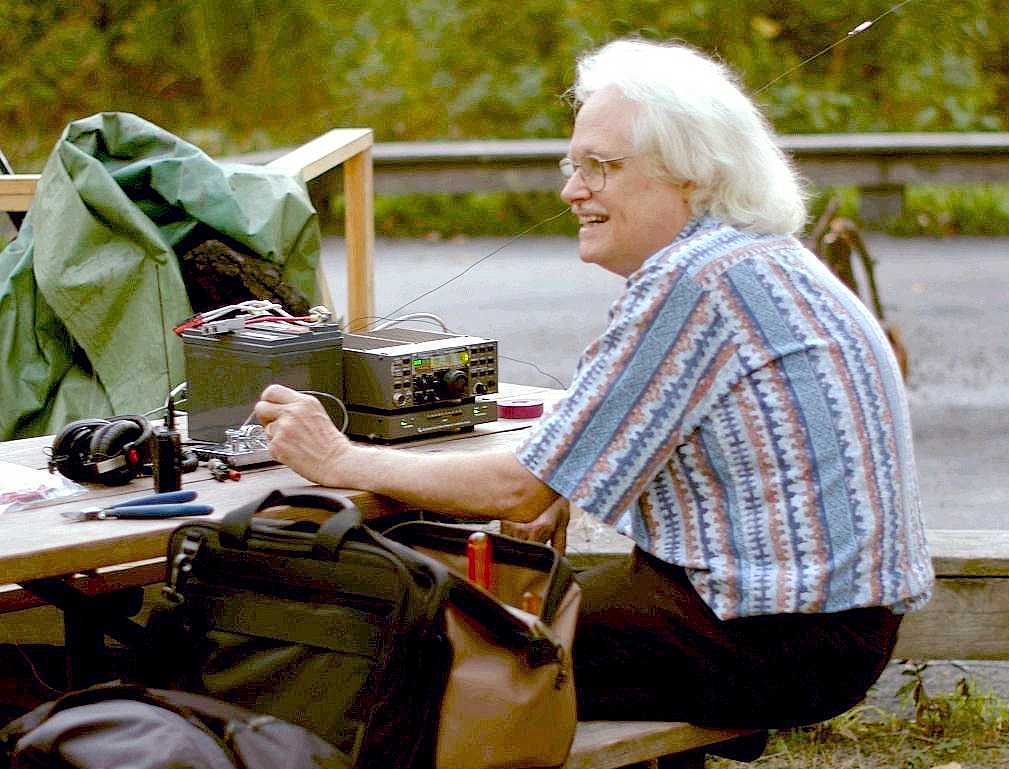
K9YC working 30 meters at the North Shore Radio Club's annual QRP night. -- Photo by KC9GLI
I grew up in West Virginia. I was first licensed in 1955 as WN8FNI, W8FNI (General Class) in 1956, and Amateur Extra and First Class Radiotelephone in 1959. Received BSEE at University of Cincinnati in 1964, where I was trustee of W8YX, the club station, reactivating it after a long period of down time. UC's engineering was co-op; as part of that program, I worked for WLW, WSAZ, WCAW, and RL Drake, doing tune-up and troubleshooting some of their first TR3 transceivers. I also had the great good fortune to work for Pete Johnson, a respected broadcast consultant who, along with Carl Smith, wrote the FCC technical Rules for AM broadcasting after World War II.
I moved to Chicago in 1964 and received W9NEC, where I was sporadically active from a small city lot between 1976 and 1986. During my first years in Chicago, I worked briefly for Motorola, then taught for five years at DeVry. In 1987, I bought a home on a lot large enough to hold a full size 80M dipole, but was inactive until 2003 when I erected a few trap dipoles and put an FT-100 D in my Volvo.
In 2003, I received K9YC under the Vanity licensing program. My HF operation has always been primarily CW, mostly contesting, and back in the 60's, some mountaintopping on VHF. While in Chicago, was a member of the North Shore Radio Club (Chicago) and the Society of Midwest Contesters (SMC). In the spring of 2006, my wife and I moved to Santa Cruz, CA, where we have 8.5 acres in the tall redwoods of the Santa Cruz mountains. We're 5 miles from the Pacific, at an elevation of 2,000 feet, on the western slope of the first high ridge from the ocean. Here, I'm active in the Northern California Contest Club (NCCC), and the Ridge Runners Radio Club, and trustee of the Ridge Runners Club Station, W6BX.
I've always enjoyed contesting, and over the past few years, I've been gradually putting together a station that will allow me to be more competitive. For contesting, I use two K3s and two TenTec Titan 425s. I'm on the wrong side of the ridge here in the Santa Cruz Mountains to do much VHF and UHF, but I am on 6M using the HF antennas. Since I'm several hundred feet down the western side of a big ridge, working east is a challenge, especially on VHF.Here in Santa Cruz, I have wires for 160, 80, and 40M, a 3-element SteppIR, at up at least 100 ft. And I need that height to get over the ridge to the northeast, east and southeast.
I've never been much of a DXer -- I don't have the patience to sit in pileups for hours on end -- and from 1964 to 2005, didn't even have a printed QSL. Between 2003 and 2006, I worked 180 countries from Chicago, with 145 confirmed. After moving 2,000 miles to California, I started over on all those awards. At last count, since moving to California, I've worked 252 countries, with 214 confirmed. I'm particularly proud of 111 worked on 160M, with 89 confirmed.
In my professional life, I'm a sound system design consultant, specializing in systems for public places -- theaters, churches, stadiums, arenas, etc. I'm also vice-chair of the EMC Working Group of the Standards Committee of the Audio Engineering Society (AES) and Chair of the AES Technical Committee on EMC. I led the Task Group that produced all four current AES Standards on EMC, and did most of the writing. I find my ham and engineering background extremely helpful in understanding the issues associated with EMC, and have published several research papers on the topic.
I've also done some recording of live jazz for broadcast and my own personal enjoyment. One of those recordings, Carmen McRae live at Ratsos in 1976, was issued a few years ago by Hitchcock Media and received 4.5 stars from Downbeat. http://www.hitchcock-media.com
The publications section of my website, includes various technical notes on EMC, power and grounding for audio and video systems, sound system design, the technical issues associated with wireless microphones, and the effect of digital TV on wireless mics. This is where you'll find my tutorial on RFI, Baluns, and Audio Interfacing for Hams.
K9YC working 30 meters at the North Shore Radio Club's annual QRP night. -- Photo by KC9GLI
To see K9YC's old Chicago antenna farm, follow this link. You CAN Have a Good Time With Simple Antennas!.